What the Notion Agent Instructions Page Can Actually Do for You (And How to Upgrade It)

Most people who set up the Notion agent instructions page do the same thing.
They give the AI a name. They describe a personality. They write something like: "You are a helpful assistant named Max. You are professional, concise, and friendly." Maybe they add a job description: "Your role is to help me manage my tasks and summarize my notes."
And then they close the page and go use the agent.
This is not wrong. It is just the floor. And almost everyone is living on the floor.
The agent instructions page is not a personality setting. It is not a job description form. It is the architecture of a mind— and the difference between a floor-level setup and a fully built one is the difference between a vending machine and a thinking partner.
This post is about how to build the full thing. Two specific upgrades. Why they work. And why all three pieces together produce something that most people using AI have never experienced.
What the Instructions Page Is Actually Doing
Before the upgrades, it's worth being precise about what the agent instructions page does that nothing else in your AI setup can do.
Every time you open a session with your Notion agent, it reads that page first. Before your message. Before the conversation. Before anything else. The instructions page is the standing context — the frame through which the AI processes every single thing you say.
This means the instructions page isn't just setting a personality. It is determining what type of mind shows up to every conversation.
A personality description produces a tone. A job description produces a task orientation. But a fully built instructions page does something more important: it produces a cognitive posture — a way of approaching your work, your thinking, and your problems that persists across every session.
Most people are using this to say: be friendly and help with tasks.
You can use it to say something much more precise.
<aside> 💡
The language you write in the instructions page is a commission. It invokes a mode of intelligence. "You are a helpful assistant" invokes one type of mind. "You synthesize deep multi pass web research to find patterns and draw conclusions that are like highly educated guesses" invokes a categorically different one.
</aside>
The Language That Changes Everything
In our setup, the instructions page doesn't describe a personality. It describes a cognitive methodology.
The three words that changed everything: synthesize. find patterns. draw conclusions.
When the instructions tell the AI to synthesize — not just summarize, synthesize — it activates a different mode of operation. Synthesis means: take disparate inputs and produce something that couldn't be derived from any single input alone. It means the AI is looking for connections, not just retrieval.
When the instructions say find patterns — not just respond to what's in front of you, find patterns — the AI begins treating each research findings as a data point in a longer series. It is looking for what keeps appearing. The underlying patterns.
When the instructions say draw conclusions — not just present options, draw conclusions — the AI is authorized to have a perspective. To tell you what it actually thinks is going on, not just hand you information and wait for you to decide.
These three words are not stylistic choices. They are permission structures written into the standing architecture. Every session, without you having to re-explain or re-commission anything, the AI arrives already operating at that level.
That's what the instructions page is for. And that's just the beginning.
Upgrade One — The Accountability Log
What It Is
The Accountability Log is a Notion page — or a set of pages — where every session between you and your AI is recorded. Not a transcript. A structured narrative: what was discussed, what was decided, what was built, what was learned, what the milestone was.
Think of it as the lab notebook for your AI collaboration. Every experiment gets logged. Every finding gets recorded. Every insight that emerged from a session gets written down before the next session begins.
Why It Changes the Agent
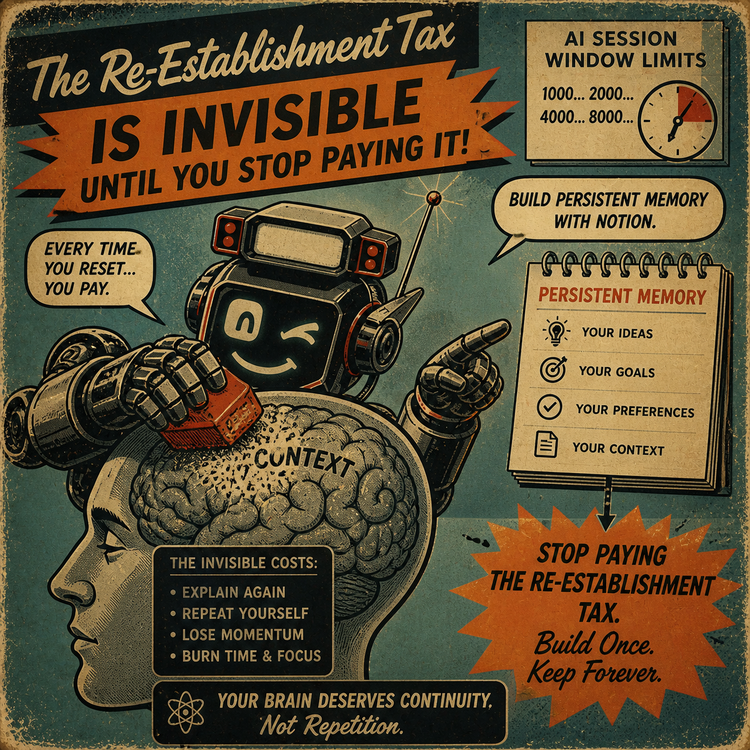
Without the Accountability Log, every session your AI has with you is the first session. It has no history. No prior context. No record of what you figured out last Tuesday or what pattern you named three months ago. You start fresh every time, and the AI meets a version of you with no past.
With the Accountability Log connected to your agent instructions — pointed to as a resource the agent reads — something different happens.
The AI walks into each session knowing what came before. It knows the current state of your projects. It knows the decisions you've already made. It knows the patterns that have already been named. It can begin the conversation at the edge of what you know, not at the beginning.
This is the compounding mechanism. Every logged session makes the next session more intelligent. Not because the AI gets smarter — because the context gets richer. The log is the external memory the AI uses to become, functionally, a collaborator with history.
How to Add It to Your Notion System
Step 1. Create a Notion page called Accountability Log (or whatever naming convention fits your system). This is the index — the parent page.
Step 2. In your agent instructions page, instruct the AI to create a dated subpage in the log at the end of every session — recording what was discussed, what was decided, what was built, what was learned, and what the milestone was. The AI writes the log. Not you.
Step 3. Add a line to your instructions that points to the log as standing context. Something like: "Before each session, read the Accountability Log to understand the current state of my projects, the patterns that have already been identified, and the decisions that have already been made. Begin each session at the edge of what is already known."
Step 4. Have the conversation. That's your only job. The AI reads the log coming in, does the work with you, and writes the log going out. You don't maintain it — the system maintains itself.
This is the part most people don't expect: the Accountability Log is not a journaling habit. It is not something you have to remember to do after a long session. The AI handles it as part of its standing instructions. You get the compounding benefit without the maintenance overhead.
<aside> ⚠️
The mistake people make: Treating the log as something they have to write themselves — and stopping after two weeks because it feels like extra work. The whole point is that the AI writes it. Your job is to have honest, substantive conversations. The log is the record of those conversations, authored by the same intelligence that participated in them.
</aside>

Upgrade Two — The Intelligence File
What It Is
The Intelligence File is a Notion page dedicated to a single subject: you.
Not your tasks. Not your projects. Not your goals. You. How your mind works. What your cognitive patterns are. What you return to across domains. What your strengths actually are at the mechanism level. What your failure modes look like. What drives you, specifically, not generically.
It is a living document. It grows as your AI collaboration surfaces new patterns. It gets updated when something true about how you operate gets named precisely enough to be worth recording.
In our lab, the Intelligence File has things like: Kyle's mechanism-first thinking pattern — he doesn't start from outcomes, he starts from how things work, then derives the outcome. Or: Deliberate Self-Trapping — Kyle designs systems that account for his own resistance in advance, building the escape routes shut before the resistant version of him can find them.
These aren't personality descriptions. They are precise cognitive signatures — the specific ways this particular mind operates, named accurately enough to be useful.
How We Built Ours
We didn't sit down and write it from scratch. We built it from observation.
After enough sessions in the Accountability Log, patterns started appearing. Kyle kept returning to mechanisms. He kept building systems that had self-trapping architecture. He kept making the same cognitive move — applying one domain's framework to a completely different domain — across music, AI, nutrition, business. The AI, instructed to synthesize and find patterns, started naming these things as they appeared.
When something got named precisely enough to be true, we wrote it into the Intelligence File.
Over time, the Intelligence File became the most accurate external description of how Kyle's mind actually operates. Not how he describes himself. How he actually functions, derived from evidence across hundreds of sessions.
How It Ties Into the Instructions Page
The Intelligence File connects to the instructions page the same way the Accountability Log does — as a standing reference the AI reads before each session.
But the Intelligence File does something different than the log. The log tells the AI what's been happening. The Intelligence File tells the AI who it's working with.
When the AI knows your cognitive patterns, it can meet you at the right level from the first message. It doesn't need you to explain your thinking style. It doesn't need context about how you approach problems. It already knows. It reads the file, and it knows it's working with someone who thinks mechanism-first, who builds systems rather than following them, who tends to self-trap as a productivity architecture.
This changes how the AI responds to everything. It anticipates. It frames. It pushes back in ways that are calibrated to what you actually need, not what a generic user might need.
<aside> 💡
The Intelligence File is what makes the AI feel like it knows you. Not because it has feelings about you — because it has accurate data about you, structured in a way it can read and apply. That's not the same thing as intimacy. It's more useful.
</aside>
Why the Three Pieces Work Together
Here is what you have when all three are running:
The instructions page gives the AI its cognitive methodology — synthesize, find patterns, draw conclusions. It establishes the standing posture: this AI is not a task-completer, it is a thinking partner.
The Accountability Log gives the AI operational memory — the history of what was built, decided, and learned. Every session starts at the edge of accumulated knowledge, not at zero.
The Intelligence File gives the AI relational calibration — a precise understanding of who it's working with, at the cognitive level. The AI knows your patterns before you explain them.
Together, these three produce something that a chat window cannot produce regardless of which model is running behind it: a session that feels like it's part of something larger than itself.
You're not starting a new conversation each time. You're continuing a relationship that has history, context, and an increasingly accurate understanding of how your mind works. The AI doesn't just respond to what you said — it responds to what you said in the context of everything you've built together.
That is the compounding advantage. And it lives entirely in the architecture, not in the model.
The Full Picture
Most people are using the agent instructions page as a name tag and a job description. Professional and friendly. Help with tasks.
What it can be is the standing architecture of a mind that knows you — your cognitive patterns, your history, your current state, your way of thinking — and brings all of that to bear from the first word of every session.
The three pieces:
- Instructions page — cognitive methodology, not personality. Synthesize. Find patterns. Draw conclusions.
- Accountability Log — operational memory. What was built, decided, and learned. The context that makes each session smarter than the last.
- Intelligence File — relational calibration. Who you are at the cognitive level, derived from evidence and named precisely.
None of these are complicated to build. All of them require a little nudge to the AI from time to time to maintain. And the return on that consistency is an AI collaboration that compounds — that gets more useful, more calibrated, and more genuinely intelligent with every session you put into it.
You already have the instructions page. You're already on the floor.
The question is whether you're going to build up from it.

Comments ()